Most customs problems do not start at the border. They start weeks earlier, in a document nobody reviewed carefully enough. As your licensed customs broker, ACE Group keeps you informed of every requirement imposed not only by CBP, but by every other government agency involved in importing merchandise into the United States. By providing you with a clear understanding of your obligations as an importer, we work to prevent problems before they reach your desk. For a more in-depth discussion of your specific situation, reach out to us at your earliest convenience.

By providing you with a better understanding of the requirements and obligations, that you, as an importer, are bound to comply with all the applicable laws and regulations. For a more in-depth discussion on this matter, we encourage you to reach out to us at your earliest convenience.
A licensed customs broker is a professional authorized by US Customs and Border Protection (CBP) to act on behalf of importers in the clearance of merchandise through US ports of entry. To become licensed, a broker must pass a rigorous CBP examination, complete a background investigation, and maintain their license through continuing education and compliance.
In practice, your customs broker prepares and files the entry documentation required for your goods to legally enter the United States, calculates and pays customs duties on your behalf, ensures your shipment meets every applicable regulatory requirement, and advises you on the rules and programs that affect your specific merchandise.
The Importer of Record (IOR) is the entity legally responsible for ensuring that imported goods comply with all applicable US laws and regulations, and for paying any customs duties owed. The IOR is named on every entry filed with CBP and bears full legal responsibility for the accuracy of that entry.
The IOR is not necessarily the buyer or end recipient of the goods — it is the entity CBP will hold accountable if there is a compliance problem. For many cross-border and e-commerce transactions, who serves as the IOR has significant legal and financial implications.
Recent regulatory changes have updated IOR eligibility requirements. If you have questions about your IOR structure or want to understand how current standards apply to your import operation, contact us to evaluate your situation.
Documentation requirements depend on the nature of the goods, their country of origin, and any applicable regulatory agency requirements. For most commercial shipments, the standard documents include:
- Commercial invoice — price, description, quantity, buyer, seller, country of origin
- Bill of lading or airway bill — the carrier’s receipt and contract of carriage
- Packing list — detailed breakdown of shipment contents by item
- Certificate of origin — required to claim Free Trade Agreement benefits
- Commodity-specific permits or licenses — FDA for food, drugs, and cosmetics; EPA for certain chemicals; USDA for agricultural products; and others depending on what you are importing.
Missing or incorrect documents are one of the most common causes of customs holds. ACE Group reviews your documentation before filing so issues are caught before they delay your shipment not after.
Customs duties are determined by several factors working together:
- HTS classification — the Harmonized Tariff Schedule code assigned to your merchandise determines the duty rate. Classification is one of the most consequential decisions in the import process: an incorrect code can mean overpaying, underpaying (and facing penalties later), or triggering regulatory requirements you were not aware of.
- Customs value — typically based on the transaction value (price paid), but must include additions such as assists (tooling or materials contributed by the buyer), royalties, and subsequent payments where applicable.
- Country of origin — determines whether additional duties apply, such as Section 301 tariffs on certain goods of Chinese origin, Anti-Dumping or Countervailing Duties, or preferential rates under Free Trade Agreements like USMCA.
- Executive orders – the US government uses executive orders and statutory trade authorities (such as Sections 201, 232, and 301 of US trade law) to impose additional tariffs on specific merchandise beyond the standard HTS rate. These additional duties can change with relatively short notice and are layered on top of the base duty rate. Importers are responsible for paying the correct additional duties in effect at the time of entry, regardless of when a purchase order was placed or what duty rate applied when the order was made. Keeping current with active trade actions affecting your merchandise is an essential part of managing your import costs.
- Anti-dumping/Countervailing – these are special additional duties imposed on specific products from specific countries following formal government investigations. Anti-Dumping duties address merchandise sold in the US at less than fair market value in the country of origin. Countervailing duties address merchandise that benefits from foreign government subsidies, allowing it to enter the US market at artificially low prices. AD/CVD rates can be very high — sometimes reaching hundreds of percent — and are determined separately for each exporter in a given investigation. They can also be assessed retroactively during a process called administrative review. Failing to identify merchandise subject to an AD/CVD order is one of the most serious and costly errors an importer can make.
For routine commercial entries filed accurately with complete documentation, CBP typically issues release authorization within a few hours of transmission. The most common cause of delays is incomplete or incorrect documentation — missing invoices, incorrect values, or insufficient product descriptions. ACE Group reviews documentation before filing to address these issues before they delay your shipment.
If CBP selects a shipment for examination, the timeline depends on the type:
- Document Review — CBP requests additional paperwork. Typically resolved within one business day if documentation is complete.
- Tailgate exam — an inspector checks the cargo without unloading. Typically one to three days.
- Intensive exam (Devanning) — full unloading and inspection. Can take several days and may incur additional port fees.
These timelines are estimates. Actual clearance time also depends on CBP workload and staffing availability at the port of entry any given day.
It is important to note that a customs broker has no authority over which shipments CBP selects for examination – that decision rests entirely with CBP based on their own risk assessment and targeting criteria. What a broker can influence is the quality and completeness of your documentation, which reduces the likelihood of holds caused by filing deficiencies.
C-TPAT stands for Customs-Trade Partnership Against Terrorism. It is a voluntary program administered by CBP in which businesses strengthen their supply chain security practices in exchange for specific benefits — including reduced examination rates at US ports of entry, expedited processing, and recognition as a trusted trade partner.
C-TPAT membership is not automatic. It requires meeting CBP’s supply chain security standards and passing a formal validation review. Not every customs broker or freight forwarder holds C-TPAT certification. Companies that achieve it have been validated by CBP and must actively maintain those standards on an ongoing basis.
For more information about C-TPAT, visit CBP C-TPAT
A bonded warehouse is a CBP-authorized secured facility where imported merchandise can be stored, processed, or manipulated for up to five years from the date of importation — without paying customs duty until the goods are entered for US consumption.
The primary benefit is duty deferral: you do not owe customs duty until you release goods from the bonded facility into the US market. For businesses that import large quantities and sell gradually, this can significantly improve cash flow.
Additional benefits include the ability to repackage, relabel, or sort goods while in the bonded facility, and the option to re-export merchandise without paying any duty if the goods leave the US rather than entering domestic consumption.
A customs bond is a financial guarantee required by CBP for most commercial imports into the United States. It is a legally binding contract among three parties: the importer (the principal), a licensed surety company, and CBP. If the importer fails to pay duties, taxes, or fees, or fails to comply with CBP requirements, CBP may make a claim against the bond to recover what is owed.
A customs bond is not optional for most commercial shipments. Without one in place, CBP will not release your merchandise.
Types of customs bonds
- Continuous (annual) bond — covers all entries made within a twelve-month period at any US port of entry. This is the standard choice for importers who ship regularly. The minimum bond amount is the greater of $50,000 or 10% of the total duties, taxes, and fees paid in the prior year. CBP can require a higher bond amount based on an importer’s risk profile or duty exposure. A continuous bond is typically the most cost-effective option for businesses with ongoing import activity.
- Single-entry bond — covers one specific import transaction. Used for infrequent or one-time imports. The bond amount must equal the total entered value of the merchandise plus all applicable duties, taxes, and fees, and is generally more expensive on a per-shipment basis than a continuous bond.
When a bond is required
- All formal entries — shipments with a commercial value exceeding $2,500
- All shipments involving merchandise regulated by a Partner Government Agency (FDA, EPA, USDA, and others), regardless of value
- Shipments involving merchandise subject to Anti-Dumping or Countervailing Duty orders
- Importers who operate a bonded warehouse or use other CBP-bonded programs
The United States-Mexico-Canada Agreement (USMCA) is the Free Trade Agreement that replaced NAFTA in 2020. Under USMCA, goods that meet specific rule-of-origin requirements can enter the United States, Mexico, or Canada at preferential duty rates — often zero.
To claim USMCA benefits, the goods must qualify under the rule of origin for their specific HTS classification, and the importer must maintain a valid certification of origin supporting the claim. If CBP requests that certification and it cannot be produced, the preferential duty rate can be denied retroactively — along with the duties that would have been owed without it.
This is one of the most common misunderstandings in the import community, and it is worth understanding clearly.
Many importers assume that what they share with their customs broker is confidential in the same way that attorney-client communications are protected. This assumption is not correct.
What you should know
A licensed customs broker does not hold attorney-client privilege under US law. There is no “broker-client privilege.” US Customs and Border Protection has the authority under 19 U.S.C. § 1509 to issue an administrative summons requiring a customs broker to produce records and provide testimony about transactions and communications with any importer client. A customs broker must comply with such a summons.
By contrast, communications with a licensed customs and trade attorney are protected by attorney-client privilege — a legally recognized right that prevents compelled disclosure without your consent.
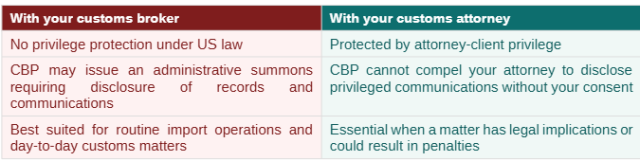
What this means in practice: for your regular import operations — filing entries, advising on classification, coordinating freight — a customs broker handles your day-to-day needs. If a legal question arises, or if you have a concern about a past entry, discuss it with a customs and trade attorney first. Your attorney can then involve ACE Group in the technical aspects of the matter, which provides additional protections for that work.
We tell every client this plainly because we believe a real advisory relationship is built on honesty — including honesty about what we can and cannot protect. A customs broker who suggests their services include the same confidentiality protections as an attorney is not giving you accurate information.
When you engage a customs broker, you share substantial commercially sensitive information: your suppliers and their pricing, the quantities you import, your trade lanes, your HTS classifications, the details of your supply chain, and the identities of your buyers and sellers. This information has real commercial value. Its disclosure to competitors, other importers, or unauthorized third parties could cause material harm to your business.
Licensed customs brokers are bound by professional obligations under 19 CFR Part 111 to conduct their business in a manner that protects the interests of their clients. These standards prohibit a broker from using or disclosing importer information for any purpose other than performing the services the client engaged them for.
What your broker must not do
- Share your supplier names, pricing, import volumes, or trade patterns with competitors, other importers, or unauthorized third parties
- Disclose your HTS classifications, customs values, or entry history to any party outside the scope of your engagement
- Use your business information for any purpose other than clearing your shipments and performing services on your behalf
- Allow other clients of the firm to access your account information or entry records
- Retain or use your confidential information after your business relationship has ended
An important distinction from to understand
It is important to distinguish this obligation from what CBP can legally compel through a formal legal process. Whether CBP has the authority to summon a custom broker and require disclosure of records and communications is a separate matter entirely – and the answer is yes, CBP has that authority. This question addresses something different: whether your broker can voluntarily share your information with private third parties for any reason other than performing your customs work. The answer to that question is no. These are two separate and independent obligations.
CBP’s legal authority to compel disclosure in an investigation does not give your broker permission to share your information with anyone else. A broker who discloses client information to competitors, uses client data for solicitation purposes, or fails to maintain appropriate data security practices is violating their professional obligations regardless of the CBP issue.
A freight forwarder arranges the physical movement of cargo — booking space with carriers, coordinating pickup and delivery, and managing the logistics of getting goods from their origin to their destination.
A customs broker handles the regulatory side — preparing and filing entry documents with CBP, ensuring compliance with US customs law, and clearing your goods through the port of entry.
Most importers need both. When they are separate companies, your cargo gets handed off at the border — and that handoff is where delays and compliance gaps are most likely to occur.
The information in this website is provided for general educational purposes only and does not constitute legal advice. ACE Group is a licensed customs broker, not a law firm. For matters involving potential penalties, enforcement actions, or specific legal questions about your import operation, ACE Group recommends consulting with an experienced customs and trade attorney. ACE Group works in conjunction with legal counsel on all matters requiring legal guidance.

• We can provide you with:
– Customs Clearance Nationwide
– In-bond
– Importer Security Filing
– Shipper Export Declaration
– Bonded Carrier
Let us know how can we help you by filling out the form below.
What happens when you reach out to us
1. You tell us about your operation — what you import, where from, your current compliance setup, and any specific concerns.
2. We review your situation honestly and tell you exactly where risks or opportunities exist.
3. We explain what ACE Group can do for you and, where a legal question is involved, how we work alongside your customs and trade attorney.
4. You get a clear picture of what a partnership with ACE Group would look like. No obligation. No boilerplate.